
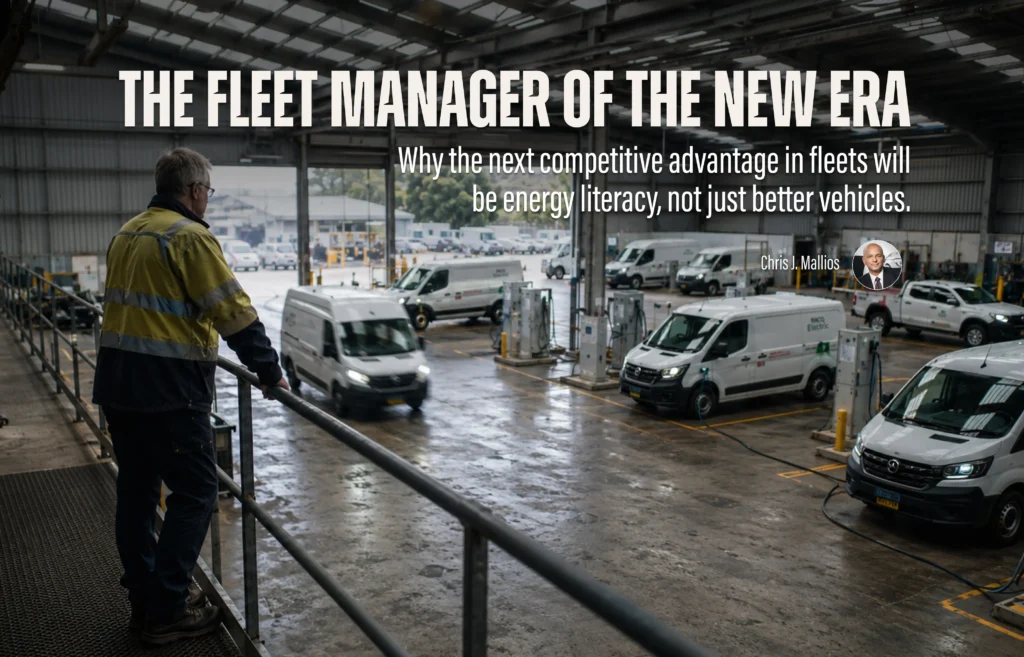
I have been spending a lot of time lately inside the operational reality of fleet electrification — not the brochure version, but the version where operators are actually moving. And while studying what the fastest-moving fleets have in common, I kept noticing something that had nothing to do with the vehicles themselves. That pattern, once visible, was impossible to ignore.
The question I kept coming back to was not about vehicles at all. It was about energy.
DHL ran into it first, at least in my research. Nine depot sites across the United States, a growing electric fleet, and a fixed amount of available power at each location. The obvious move was a utility infrastructure upgrade. The less obvious move, the one they took, was to install adaptive load management software with PowerFlex that distributed the available power intelligently across chargers based on vehicle schedules and live demand. The outcome was 415 chargers across all nine sites. Double what unmanaged charging would have permitted. Same power limit. No utility upgrade. No eighteen-month wait.
Same sites. Same power. Twice the chargers. The difference was not the hardware. It was the thinking.
Then there is Amazon, which now has over 30,000 Rivian electric vans on the road in the United States, part of a 100,000-van order, supported by more than 50,000 chargers across 250 delivery stations. Those vans delivered over one billion packages in 2024. The headline is always the vans. The real story is that Amazon had to become one of the largest private operators of charging infrastructure in the country just to make the vans operationally viable.
And then Fortescue, in the Pilbara. Their first in-house developed 6 megawatt fast charger has commenced commissioning, purpose-built to fully charge a single 240-tonne Liebherr electric haul truck, carrying a 3.2 megawatt-hour battery, in approximately 30 minutes. Six megawatts is roughly the draw of a small town. At that scale, you do not plan energy around the operation. You plan the operation around energy.
Three industries. Three scales. One shift in thinking.
Diesel fleet management has always been a supply chain problem. Fuel is a commodity, purchased, stored, pumped in ten minutes. The vehicle is the unit of thinking and the rest is logistics.
Electric fleet management is an operations problem. The vehicle, the charger, the site grid, the shift pattern, the tariff structure and the software all interact, and they interact constantly. When do the vehicles charge? How much power is actually available on site? What happens when five trucks return and plug in simultaneously at the end of a shift? Does the charging window fit the duty cycle? Is the fleet quietly accumulating peak demand charges that nobody has noticed yet? Who is watching charger uptime when a vehicle needs to be out the gate at five in the morning?
These are not vehicle questions. They are energy management questions. And the honest truth is that most fleet operations teams were built to answer the first kind, not the second.
The fleets extracting the most value from electrification are not necessarily running the newest vehicles. They are the ones that have started asking fundamentally different questions about how their sites, their shifts, and their energy work together.
The fleet manager of the next decade will spend less time thinking about fuel consumption and more time thinking about power allocation. That is not a small change. It is a different job.
What that looks like in practice, for industrial fleets and site vehicles, is what I want to explore next.
© Copyright 2026 Tembo e-LV BV | Privacy Policy